Perfecting online
acquisition at SumUp

Role: Product / UX Designer

Company: SumUp Payments

Context: Growth & Acquisition — LATAM

Timeline: 2022–2024
+60%
Overal conv. rate
-80%
Acquisition costs
+50%
Upmarket Share
"Growth needed to stay efficient while the product shifted upmarket. The acquisition funnel was the sharpest lever available."
In 2022, SumUp was scaling rapidly across Latin America while simultaneously repositioning toward higher-value merchant segments.

That combination created a specific tension: cost per acquisition couldn't balloon while the messaging needed to shift upmarket.

The acquisition funnel had significant room to improve.
My role
I didn't start with design. I started with data.

The first step was a full funnel audit: mapping drop-off points, identifying where users hesitated, where they left, and where messaging created confusion.

That audit shaped a prioritized backlog of hypotheses — each one specific enough to test and measure.

The funnel was treated as a living product surface, not a project with an end date.
What I changed
and why
01 — First-screen clarity
Hypothesis: "Users leaving early aren't confused about pricing — they're confused about relevance. Answering 'is this for me?' faster will reduce early drop-off."
Restructured hierarchy to answer three questions in the first screen: what is this, who is it for, what should I do next
02 — Trust architecture
Hypothesis: "For higher-value merchants, trust signals matter more than for the general flow. Positioning them at hesitation moments will improve conversion."
Repositioned social proof, certifications and partner logos at decision moments — not decoratively at the top.
03 — Messaging alignment
Hypothesis: "The existing copy was still optimized for small merchants. Shifting to speak to the new target segment will improve quality of conversions."
Reworked messaging hierarchy on key pages — adjusting tone, foregrounding different capabilities, aligning with updated brand standards.
04 — Friction reduction
Hypothesis: "Small UX changes at high-volume steps compound quickly. Reducing unnecessary fields will improve self-service completion."
Reduced fields, clarified error states, improved feedback loop at each step of the self-service onboarding.
Results
+60%
Overall conversion rate across acquisition and onboarding flows
−80%
Acquisition costs — more conversions, same spend
+50%
Upmarket segment share — repositioning reflected in who was converting
+30%
Self-service funnel conversion rate
20K+
Qualified leads generated for the in-house
sales team through optimized web funnels

But wait, there's more

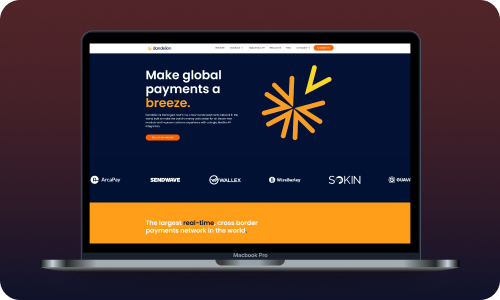
Check what I did with
Dandelion's payments website
Design system, CRO and 70% faster load times.
PRODUCT DESIGNER · PAYMENTS · GROWTH · ART ·